Yesterday morning at around 3am I woke up and headed off to my personal session I booked regarding The Howls, as seen in earlier posts. This session was a re-amping session, and I'll briefly explain that before I move on. Re-amping is basically taking a recorded sound and running it through an amp, miking the amp and recording that as a new track. I didn't use amps and microphones though, but pre-amps. I was able to get away with this because of the way that Digidesign pre-amps are made, which are very "invisible", and don't add much tone to the sound. If you record first with a pre-amp that doesn't add a lot of tone, then you can do more with it later, like send it through another pre-amp, which is what I did yesterday morning.
Anyways, I sat in the studio clicking the chicken head knobs up and down to get whatever tone I desired. It was my unannounced artistic feel that led me to each decision. Drive the pre's, back off the pre's, which frequencies to use on the Germanium Tone Controls, and EQ on the Neve 1073. While the musician/client is always in mind, and what I am doing is only emphasizing what they want, without anyone there with me at that stupidly early hour of the morning I am artistically visualizing what I think the client wants. Also, I had my "so what" moments when I felt like the pre's were driving too hard for their taste. It sounded awesome to me.
From the moment you set up a microphone, your name is all over that recording, no matter who is spittin' over those fat beatz. The level that you commit to multi-track, the amount of compression, or EQ, it's all you. These things are subtle, definitely, but over time they amount to a giant signature, and no one else can duplicate it. Every year, during a certain season at a specific time of day under exact weather conditions, people come with all of their camera gear to the exact spot where Ansel Adams took one of his famous photographs of Yosemite and the Half Dome. I can guarantee you that even if someone where there with Ansel Adams with the exact same camera and film even, they would not be able to produce the same photograph. If you want to be like Ansel Adams, don't join the hordes of photographers to take pictures just like someone else, but go off in your pick-up truck that you fashioned into a dolly of sorts and live photography.
The same holds true for recording. You can't make your tracks sound like his or hers. You may have the same style, but striving to be someone else will only hold you down. Great leaps in art are made by people doing something completely different. This is up to you, I suppose. Do you want your tracks to sound like radio trash that has no feeling or life left after it's been pushed out of the beat-detective and auto-tuning tube, all factory ready? Or do you want to alter the way people think by employing such heinous techniques that people would only see it as pure genius? Alright, maybe not heinous, or pure genius, but different, and skillful. We're still engineers here, so let's not get carried away, but the principle still remains.
So now I hope you can go out into the world of audio engineering and define you. I thought up a really good analogy for this earlier today, but I just watched a Mystery Science Theater 3000 and completely forgot.
Friday, February 12, 2010


Wednesday, February 10, 2010
Knowledge Is Power! (Inspired by Melissa Rodwell)
My safari homepage is a fashion photography blog by Melissa Rodwell. (Very random, I know, but I am an amateur fashion photographer.) Today she posted a blog about knowledge, and understanding fashion photography to it's fullest. Not only fashion photography, but fashion itself. She named off all these types of clothes that I didn't know and talked about Coco Channel. I suppose it's time that I talk somewhat on this subject as well. (Not fashion photography, but understanding the industry in it's entirety.)
How does this apply to the audio engineer? There are a few different aspects of audio engineering that we have to fully understand to become masters of audio. (Like Bob Katz.) What I'm saying is that the knowledge that audio engineers should have, more or less, is the understanding of how a sound is produced, transduced, manipulated and arranged from beginning to end. This attention to detail separates the bed-room enthusiasts from the Jedi's of recording. Jedi's, yes. More like bed-room padawans than enthusiasts.
First off, the reason you wanted to become an audio engineer, hopefully, is music. (I know I'm forgetting about all you Post-Production people right now, so imagine that I'm talking about sound in general.) Now, music in and of itself is a vast and extensive subject that requires years of study to start to comprehend it. Your understanding of music will help you to mix a band more logically according to the arrangement and genre. You are the invisible conductor, so if you don't know anything about the music that you are mixing, how will it turn out sounding good? The music is the first thing that you have to focus on, and the most important thing! Sufjan Stevens has recorded several albums with techniques scoffed at by the religious right of the recording industry, but these techniques promoted his music and his over all sound in an impressive way. First, music, then engineering.
The next aspect that I want to look at is the sound itself, or the acoustics of audio. Each one of these topics could be a blog themselves, but I'll save expanding upon them too much for a later day. I've got a deadline with this one. As an engineer you absolutely need to understand the sound that is produced by each instrument. Several times I've seen people make their microphone lists without ever hearing the instrument, then when they go to record, they set up the mics on the instruments without hearing them played! This happens, and it's downright stupid! Understand where different tones are produced on a guitar, and how to smooth out an amplifiers punch or emphasize it. Know how to affect certain things, like drums, and why the pitch bends up or down after the tom has been struck. Understand how sound travels, how it bounces, and be able to manipulate it's path with different surfaces such as baffles or gobos. When you understand how instruments are creating the sound, and how that sound is reacting within the room, only then can you decide which microphone would best suit the instruments musical needs.
Which brings me to microphones, gear, and signal flow in general. This is something that you can understand on two levels: 1. How it will affect the sound, and 2. Why it will affect the sound. The first is on a tonal level. Neumann microphones will give you tons of presence, tube gear will give you a "warmer" sound. The second level is more of an electronic understanding. Tube gear will actually roll off transients because of the nature of the electrons passing through the tube, therefore de-emphasizing a portion of the signal with the most high-end information, giving you more low end which to your ear will sound "warmer". Just a side note, this is why solid-state sounds harsh, but in reality, solid-state is a truer representation of the input sound. Anyways, understanding your gear is a very important thing. As soon as you get a new piece of equipment, test it with all you have, to it's limits. Know how the gear will handle in every situation.
There is still so much more in audio that can be learned, I haven't even started digital, but because of time, and for the sake of this post getting too lengthy, I'll stop there. What you need to do, if you truly are an audio engineer, is understand every aspect of audio, not just beat-making. I guess my point is this; you have to get in the water completely before you learn to swim.
"Wait a minute," you say, "what makes YOU an engineer?"

Um, obviously the legit cardigan.
In the words of my Advanced Recording and Production instructor George Borden, "Feel it."
Friday, January 22, 2010
Listening Levels
I just saw a little clip for the upcoming news show the
other day where a guy was driving in his car listening to music saying
something like, “Does your cat make too much noise all the time???” Haha, I’m
just kidding. No, he was asking how loud was too loud?
Sitting next to this guy at the airport where I can hear his
headphones reminded me of this, and I want to let you in on this. The news
reporter said something about hearing what the experts are saying, at 10, so I
suppose that makes me an expert. I will continue this post as such.
All mix engineers, hopefully, know that 83dB (decibels) is
the best volume to mix at. This is measured in SPL (Sound Pressure Level), and
can be accurately read by an SPL meter found at RadioShack. (The last time
you’ll hear me saying something nice about that store.) Engineers mix at 85dB
not because they won’t lose their hearing, but because it is the flattest
frequency response. (What does that even mean?) I’ll tell you.
People hear frequencies better than others at certain
volumes. If you turn down your stereo, you can hear the vocal range and snare
drum much better than you can hear the bass, or the kick drum. When you turn it
up, everything changes. The fact of the matter is that it does sound better at
louder levels, but go too loud, and it won’t be an even level again. “Frequency
Response” is the term engineers use to define how different a sound changes
from it’s original sound to how it sounds coming out of your speakers. Most
manufacturers of consumer speakers will change their frequency response to make
you think they sound better than other speakers. They’re not necessarily better speakers, but they’ll
emphasize frequencies that bring out certain things in pop music, like vocals. A flat frequency response should be
desired, which means that no frequencies are emphasized or de-emphasized, and
you are hearing more or less exactly what the mix engineer and mastering
engineer intended for you to hear. These speakers are usually very expensive.
The Fletcher-Munson Curve is a chart which plots out which
frequencies are best heard at certain levels in relation to the other
frequencies at that level. It’s confusing, but here is the Fletcher-Munson
Curve.
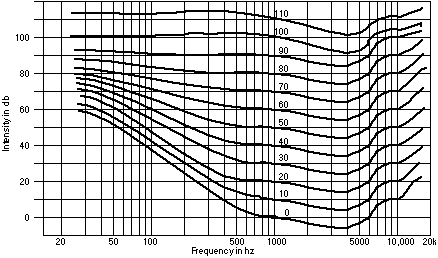
The flattest frequency response according to the
Fletcher-Munson Curve is 83dB, which is why mix engineers mix at this level. It
also happens to be about the loudest level you can listen to for an infinite amount
of time without any hearing loss. If you are listening to music at 85dB, you
can carry on a loud conversation with the person next to you comfortably. At
90-95dB, you can’t listen to music for more than 8 hours, or else you’ll start
to damage your hearing. 115dB, or rock concert loudness, will damage your ears
in less than an hour.
It is very common for people to listen to music too loud in
their cars. The roar of the engine combined with the road and the wind already
make the car a noisy place. Drowning these out with music will easily get you
up to 90dB. Add in the fact that you’re in a small, enclosed space of flat
reflective surfaces bouncing back that music, which is trying to compete with
volume of your voice bouncing straight back in your face, and that level can
easily reach 100dB if not more.
Be careful out there. You don’t want hearing loss, or
tinnitus. Wear earplugs at concerts, don’t roll the windows down when
you’re on the freeway, turn your earbuds down when other people around you are
bobbing their heads to the same beat.
Wednesday, January 20, 2010
Another Day With The Howls
Saturday I flew in from SF, went to lunch with my family and got straight to work at John's house tracking his guitar parts. Everything went rather smoothly. I mean, as smoothly as it can go with an old upright M-Box with the face falling off and the headphone jack coming out of the side.
 Well, what else can you really do? I sat there, on an old Mac running Pro-Tools 7 with one processor of 1.67MB of RAM, which maximum capacity was recording 1 track of audio for 5:30 minutes before it crashes. I figure, without limitations, what summons creativity?
So I got some of the best guitar sounds ever. To be honest, I wish I had a Sennheiser 421 to get the lower end sounds of the guitar amp to recreate the "warmth" that they wanted, but the SM57 worked just fine. And in the end, who really cares?
We recorded Boaz's guitar Sunday. The tones I was getting from him with just a 57 were killer. Some tracks I used a small cap condenser on, but for the most part, the 57 carried most of the weight.
I realized something while I was sitting there, in a bedroom, in an apartment a few blocks away from the beach, with equipment that I probably wouldn't even have the heart to give to someone for free (for the purposes of audio recording). I realized that I honestly didn't care what equipment I had, it sounded good because this was real music. I'm sure I will rarely experience that in a professional career as a producer. There we all were, with our Arizona green tea and our M-Box, just ready to rock.
I was in the heart of American music. I am working desperately to capture its sound and deliver it to you uncontaminated by greedy hands by this summer. (Oh what a deadline...) By uncontaminated, I mean I am free to give The Howls exactly what they want without a company breathing down my neck as I mix. (I've had people breathe down my neck as I have mixed before, it's not good.)
Today was more relaxed. John and I were at it again, but this time it was just him and I, recording his vocals in his room behind windows pattered on by the evening rain. I fashioned a pop screen out of a coat hanger and some nylon tights in about 2 minutes flat. (I've never done that before, but I've heard it works. It does, really well actually, but it looks so stupid.)
It's really amazing to see these things come together, and probably my favorite part as an engineer. When you begin a session, you start setting up mics to capture the best sound, and you record these parts, and parts and parts, and keep making them sound good. For me, when the singer records his/her part, it becomes a song for me, and that's so cool to see. An artist unfolds an idea right in front of your eyes, and it comes to fruition. What amazed me more was how killer everything sounded. I mean, this was a bedroom, with 6 different mics, and an outdated M-Box with the guts spilling out, and listening on some old computer speakers that you probably remember playing Command and Conquer on.
Wait till I get The Howls into a studio.
In other news, I hand-crafted the grill to my microphone today, and found out that the most important part won't arrive while I'm home, which really annoys me. That's ok. I'm still missing parts. I think I'll be done if I work hard on it tomorrow.

Friday, January 8, 2010
Photo-Adventure
Today I had nothing to do, which is not out of the ordinary for me, but unlike most days, I decided to gear up and go on a photo-adventure. Where? I had no idea, so I just drove.
Anyways, I'm not going to type much right now because the world is spinning like a thousand books around a toothpick. My chair is twenty feet below me, and I am a thousand feet up in the air. My computer screen keeps running away from me. I'm continually falling. I think I'm sick. Either that or just extremely tired, and I've got a headache. Dehydrated maybe?
Anyways...
Here are some photos.


Tuesday, January 5, 2010
Home Recording
Last Saturday I had a great day recording Dave, drummer of The Howls. It is so nice to work with professionals!
Speaking of professionals, all the pictures here were taken by Corinne, Dave's girlfriend.
Alright, so here's the thing, I'm tired of always teaching and writing crazy "How-To" blogs. This one will strictly be photos and small explanations of what the photos are. If you ever want your drums to sound like The Howls, this blog will help, but I'm not going to teach you how I did it.
This is Dave getting all set for recording! He was taking his time tuning his drums to sound perfect, and I am so thankful. You can see here the subkick on the kick drum that I made out of a speaker cone. If anyone is interested I'll write a blog on how to make one. You can also see here my general recording set up.

Here's how it went down. My dad and I went out to Lou's to get some light bulbs and hardware for the microphone I'm building about a half an hour before the session. Maybe 20 minutes before the session, Dave tells me that we can't use the Firepod as planned, which would have given me 8 channels into Logic Pro. I was planning on using 9 microphones, but now I've got (basically) 1 input to Pro Tools, the M-Box2 Mini. Using the mixers in this picture, and the trick I posted on syncing Logic to Pro-Tools, I managed to pull 4 channels pretty much out of thin air. 6 mics into 4 channels, and it sounded AMAZING!

Here you can see the mixers and how I used them. Maybe not how I used them, but that I did indeed use them. We just set this all up in my parents living room. It actually turned out really nice sounding.
Here are some more photos from the session. Over all I had fun. It was such an awesome and productive day. Be on the lookout for The Howls new album coming out this summer!


Again, The Howls, working on their new album that will be out this summer!
Also, not this recording, but an earlier home recording of The Howls that I did can be heard at my myspace.
-Steve
Friday, January 1, 2010
Pre-Production
Today I worked with a band through pre-production. I have no idea how many readers I get who want to be producers, but if you do want to be a producer, or an engineer, listen up! Pre-production is one of the most important things you will ever do, and I will tell you why.
What do you even do in pre-production? In pre-pro, you have to ask the artist what their vision is for the project. This is based upon a few things.
Sometimes the producer will help an artist through rough spots in their songs. Luckily for me, I didn't have to worry about that. This is potentially a super hard thing to do. Artists, like anyone, are really touchy about their work, so you need to be gentle. Suggest, don't force, your ideas. A good producer says, "Why not?" more than, "Why?". Always keep the project in mind. With that, I glide ninja style through a segue that carries me to...
The project. (sneaky) This is the theme. Answer questions like, "What is this album trying to convey?" and, "What sort of sound/feel are we going for?". As producer you are considered responsible for the sonic quality of the recording (and legally obligated to do so if you sign a contract with a label). Write all this down! Never lose the vision of the album. Sure, this can change, and the songs may change once in the studio, but without this, you are nowhere. Ask the band for reference tracks. (Ooh, that's the first time I've ever italicized something.) Reference tracks are songs that the artist wants to sound like. These will be extremely helpful for you when you are recording/mixing/mastering/eating/sleeping. Actually, while I write this, I'm listening to reference tracks, like a multi-tasking maniac. Anyways, you need to know what the artist wants. That is why you're working with them in the first place. You are the servant of servants. You serve the artist, they serve the fans. Get 3 or 4 reference tracks, at least one from every member of the band. If the bass player says he wants to sound like James Jamerson from Motown, you go and listen to any song Jamerson has played in. There are limitations as to how well you can do that with a microphone and processing, depending on how well the actual instrument sounds like the reference track, but if the band is trying to reach the same goal as you, it should be fine. For instance, I've got a drummer who wants really dead toms. I can't do that. That's completely up to him to figure out how to do that. But if he gets the sound he's looking for and says he wants to sound like John Bonham, then I'll pull out 414s, employ the Glyn Johns technique with some U87s for room mics. (Make sure he's beating the drums like they owe him money.)
The next thing that I would like to address is the long term business plan. What are you planning on doing once the record is complete? This may help you decide how many songs are going to go on the record, and also help define the general feel of the record.
Meh, I'm tired. Sorry readers. I think that's enough for one post. Tune in next time to hear about recording. Also, coming up, how to build your own microphone.
Sincerely
Steve.
Subscribe to:
Posts (Atom)